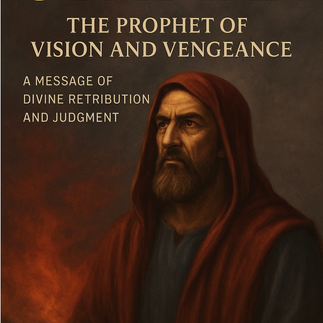
OBADIAH — The Prophet of Vision and Vengeance
Personal Life (Birth to Death):
The name Obadiah means “Servant of Yahweh.” Little is known about his background, family, or death, but his very anonymity amplifies his message: his identity was swallowed in his assignment. Scholars believe he lived around 845 B.C., during the reign of Jehoram of Judah, and may have been a contemporary of Elijah and Elisha. Some traditions even link him to the servant of Ahab who hid the prophets from Jezebel (1 Kings 18:3–4), though that is not confirmed. Regardless, his life is marked by devotion, humility, and courage — a servant who dared to speak against Edom, a nation born from Esau’s lineage, for its betrayal against Israel. His book, though brief, carries eternal judgment and prophetic clarity.
Calling and Audience:
Obadiah’s prophetic calling was to deliver judgment against Edom, Israel’s brother nation, for its violence and pride. His audience was both Edom and Judah — two nations bound by history but divided by hostility. Edom had rejoiced over Judah’s downfall and participated in plundering Jerusalem. Obadiah’s message declared that God saw their betrayal and would bring justice. His vision was not local; it was global — pointing to the “Day of the Lord” when all nations would be judged for their treatment of God’s people.
Trials and Challenges:
Obadiah’s challenge was boldness. He had to confront a neighboring nation that prided itself on military strength and mountain fortresses. Speaking judgment to Edom meant defying a proud people who trusted in their own security. His words dismantled arrogance and warned that pride always precedes downfall. It takes a servant’s heart to deliver a king’s decree; Obadiah’s courage proved that humility and authority can coexist in one vessel.
If He Lived in Jesus’ Day:
If Obadiah had lived during Jesus’ ministry, he would have stood among those crying out for justice and reconciliation. He would have been a voice of truth in the face of betrayal — like John the Baptist confronting Herod. His message of divine retribution would have found fulfillment in Christ, who taught that vengeance belongs to God alone. Obadiah would have understood the cross as the greatest act of justice and mercy combined — where betrayal was answered with redemption.
Strange or Distinct Ways He Lived:
Obadiah’s distinction lay not in behavior but in brevity. His entire ministry is contained in one chapter — yet that single vision reveals volumes about God’s character. His concise message showed that prophecy is measured by impact, not length. He did not build temples or perform miracles; his assignment was a sentence — yet it became Scripture. His life teaches that even short seasons of obedience can echo through eternity.
Lessons from His Life:
Obadiah teaches that silence does not mean insignificance. The smallest assignments can carry eternal weight when carried out in obedience. He reminds us that God’s justice is precise and His memory is perfect — He forgets no betrayal, and He forsakes no covenant. Obadiah’s prophecy proves that God defends His people, and that those who rejoice in another’s fall invite their own. His life shows that prophetic ministry is not about self-expression but divine representation.
Economic Status — Rich or Poor:
While the Scriptures give no record of Obadiah’s wealth, his servant-hearted name suggests humility over affluence. If he was indeed the same Obadiah from Ahab’s court, he once held a high position but used it to protect prophets, not to profit himself. His example shows that spiritual wealth always outweighs material possessions — and that true power is found in servanthood.
Why a Prophet’s Calling Is Different from the Other Fivefold Offices:
Obadiah’s ministry demonstrates the prophet as a defender of covenant justice. While apostles establish order and pastors nurture souls, prophets uphold divine law and equity. They speak for the voiceless and confront pride in power. Prophets do not only comfort; they confront — ensuring that God’s moral order is maintained in the earth. Obadiah’s short but sharp message captures the essence of prophetic authority: to decree heaven’s verdict without compromise.
Destiny, Legacy, and Eternal Assignment in the Earth:
Obadiah’s destiny was to announce the downfall of pride and the vindication of covenant people. His legacy lies in the principle that God restores what others rejoice to ruin. His eternal assignment continues wherever injustice reigns — to remind nations and leaders that pride will meet its day of reckoning. His prophecy endures as a warning and a promise: God will always have the final word.
Occupation / Natural Vocation:
If the tradition linking him to Ahab’s court is correct, Obadiah’s natural vocation was administrative — a palace steward who feared the Lord more than his master. He used his position to preserve the prophetic voice during persecution, hiding prophets in caves and feeding them. His earthly work became his divine training ground — managing resources while safeguarding revelation.
Personal Observation & Practical Application (Prophetic Insight for Today):
Obadiah’s life speaks powerfully to prophets today: stay faithful in obscurity. You don’t need a stage to carry a mantle. The modern prophetic movement must recover the humility of Obadiah — those who speak once but shift nations. His example challenges prophets to confront pride wherever it hides — in nations, churches, or hearts. The plumbline of heaven still drops through those who are unseen but unbending. The Obadiah mantle is rising again — defenders of justice, protectors of truth, and servants who never seek glory but always reveal it.
Would you like me to now create the Obadiah flyer, using deep crimson, steel gray, and gold hues to symbolize divine vengeance, justice, and covenant preservation?